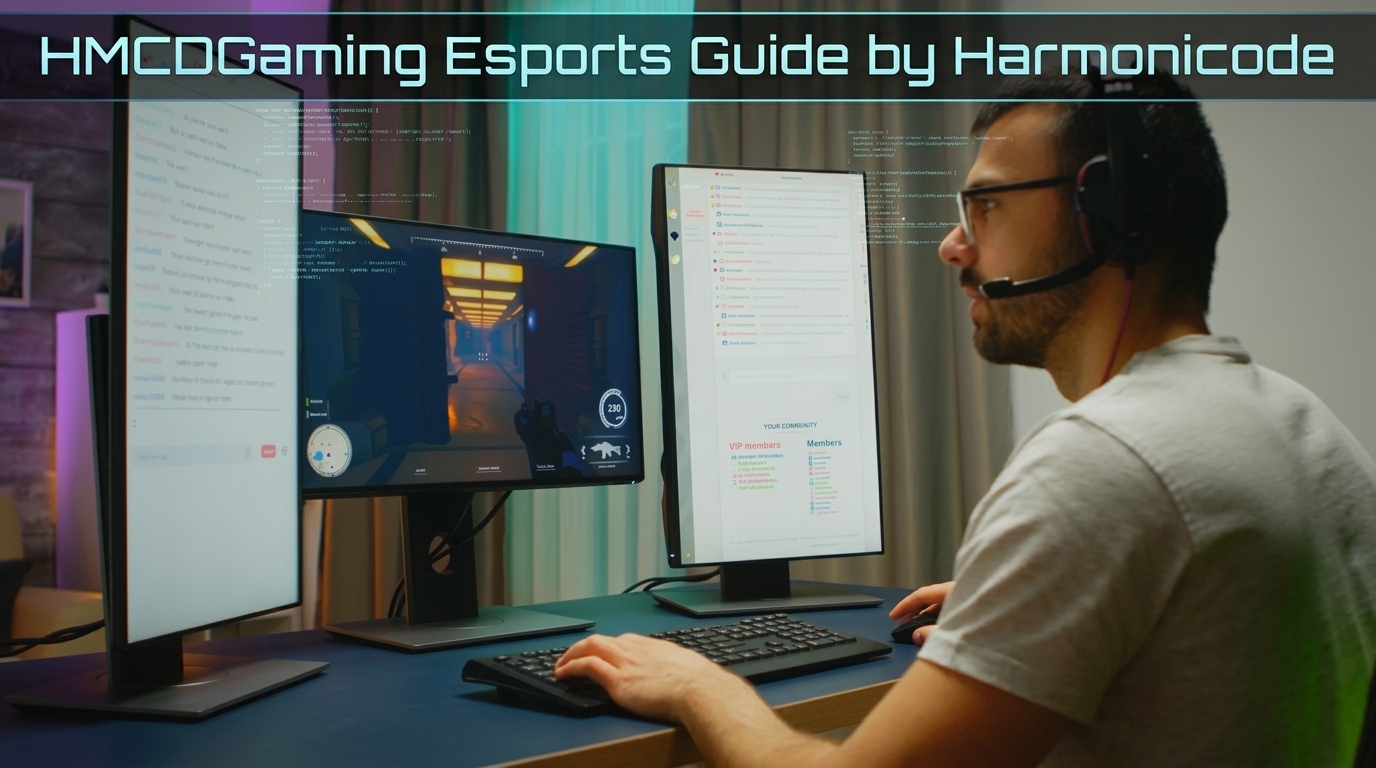
The HMCDGaming esports guide by Harmonicode is a practical framework for improving at competitive gaming. It covers mechanical skill, game tactics, team coordination, and tournament preparation. Players who follow a structured practice system improve faster than those who only play matches.
Quick Reference Table
|
Area |
Focus | Best For |
Common Mistake |
|
Mechanics |
Aim, reaction, execution drills | Solo improvement | Only playing ranked matches |
| Tactics | Map control, economy, matchups | Mid-level climbers |
Copying pro strats without fundamentals |
|
Team play |
Roles, comms, scrims, VOD review | Team players | Practicing without review |
| Tournament prep | Routines, nerves, format rules | First-time competitors |
Cramming practice the night before |
What Is the HMCDGaming Esports Guide by Harmonicode?
The HMCDGaming esports guide is Harmonicode’s playbook for competitive gaming. It brings together the skills, strategies, and habits that separate players who climb from players who plateau. Instead of focusing on one title, it works as a game-agnostic system — the same principles apply whether you queue up in a tactical shooter, a MOBA, or a battle royale.
That matters because most esports advice is scattered. You find a video on aim training here, a forum thread about scrims there, and a streamer’s opinion somewhere else. This guide organizes those pieces into one path so you always know what to work on next.
A useful way to start is by identifying your current tier:
- Casual player — you play for fun, sometimes ranked, with no structured practice. Your fastest gains come from mechanics and settings.
- Competitive player — you take ranked seriously and review your own play occasionally. Your fastest gains come from tactics and loss review.
- Tournament-ready player — you compete or want to compete in organized events. Your fastest gains come from team coordination and preparation routines.
Find your tier, then read the sections aimed at the tier above it. That is the shortest route to the next level.
Who Is This Esports Guide For?
This HMCDGaming player guide serves four groups, and each should enter it differently:
- Aspiring esports players who want to go from good to competitive should read every section in order.
- Ranked grinders stuck at a plateau should jump straight to core skills and the solo queue strategies section — plateaus are usually a tactics problem, not a mechanics problem.
- First-time tournament entrants can skim the skills sections and focus on tournament preparation.
- Fans who want to understand what pros actually do differently will get the most from the strategies and common mistakes sections.
If you only have thirty minutes this week, read the section for your tier and the common mistakes section. Fixing one bad habit often produces faster improvement than adding a new drill.
Core Skills Every Competitive Player Needs
Mechanical Skills — Aim, Reaction Time, and Execution
Mechanics are the entry ticket to competitive gaming, not the win condition. Past a certain point, everyone in your lobby can aim. What separates players is how rarely their execution breaks under pressure — and that comes from structured practice, not extra matches.
A simple daily block works better than long, irregular sessions:
- Warm up (5 minutes): low-intensity tracking or movement drills to wake up your hands and eyes.
- Train (10 minutes): one focused drill on your weakest mechanical skill — flicks, tracking, crosshair placement, or last-hitting.
- Test (5 minutes): a scored drill to measure progress.
Use a progression rule: only increase drill difficulty when you can complete your current level with roughly 80% accuracy. Pushing difficulty too early builds sloppy muscle memory, and unwinding bad mechanics takes far longer than building good ones.
Also audit your setup once. Sensitivity, DPI, refresh rate, and input lag are one-time decisions that affect every match you play. Changing them constantly resets your muscle memory.
Game Sense and Tactics
Game sense is the ability to know what is happening — and what is about to happen — without seeing it directly. It is what people mean when they say a player “reads the game well.”
You can build it deliberately with a three-step loop: predict, confirm, adjust.
- Predict: before a round or fight develops, state what you expect. “Their jungler will path topside.” “The enemy team will stack B on retake.”
- Confirm: play the round and check whether your prediction held.
- Adjust: if you were wrong, ask why. A wrong prediction with a known reason becomes information. A wrong prediction without one stays a mystery.
Run this loop silently every match and your decision-making compounds fast. Map control, economy decisions, and matchup knowledge are all just applications of it — knowing which areas of the map give you information, when to spend and when to save, and which opponents punish which habits.
Mental Performance — Tilt, Focus, and Confidence
Every competitive player tilts. The difference is that strong players recover in seconds, not games.
Use this reset checklist the moment you notice frustration changing how you play:
- Name it. Silently label the emotion — “I’m tilted because that round was lost to a lucky play.” Labeling interrupts the spiral.
- Narrow your focus. Pick one controllable action for the next round: crosshair placement, a callout, a utility timing. Tilt lives in things you can’t control; focus lives in things you can.
- Shorten the horizon. Stop trying to win the match. Win the next round, then the next.
Two session rules protect your long-term performance. First, cap losing streaks: two or three consecutive losses is the right time for a break, because queueing again while tilted usually costs more rating than the break does. Second, end sessions on a deliberate note — one last focused game or drill — so your brain files the session as progress rather than failure.
HMCDGaming Esports Strategies That Actually Work
Strategies only work when they match your level and your situation. This HMCDGaming esports strategies section splits them by context: solo queue, team plays, and mid-match adaptation.
Solo Queue Strategies for Climbing Ranks
Solo queue rewards consistency, not heroics. Three principles carry most climbs:
- Narrow your champion or agent pool. Deep knowledge of a few options beats shallow knowledge of many, especially below the highest ranks. One-tricking is a legitimate climbing tool; flex it slightly if your picks get banned or countered.
- Choose a carry-compatible role. Some roles influence the map more directly than others. Pick the role whose impact style matches your strengths — aggressive players often climb faster in high-impact roles, while methodical players may perform better in supportive ones.
- Review losses, not wins. Wins hide flaws; losses expose them.
That last point deserves a system. After every loss, spend five minutes on this loss audit:
- What was the turning point? Identify the single decision — not the unlucky play, the decision — that swung the game.
- What did I know at that moment? Separate “bad decision with good information” from “bad decision because I lacked information.”
- What is one thing I’ll do differently next game? One. Not five. One change per game is a rate your brain can actually apply.
Ten loss audits produce more rating than ten extra games played on autopilot.
Team Strategies — Roles, Communication, and Coordination
Teams rarely lose because of skill gaps at the same level. They lose because of coordination gaps: five skilled players making five individual plans.
Fix the structure first:
- Define roles explicitly. Who initiates, who anchors, who makes the final call, who gathers information. Ambiguity here costs you every close round.
- Agree on a default. A “default” is your team’s standard opening setup for an unknown situation. Having one means you never start a round deciding what to do — you start it already doing it.
- Scrim with intent. A scrim without a goal is just a longer ranked game. Enter each session with one question to answer, such as “does our retake setup work against fast pushes?”
Communication is where most teams leak. The fix is a communication hierarchy:
|
When |
What to call |
What to skip |
|
Before contact |
Intent, positions, timing (“rotating A in 10”) |
Speculation (“they’re probably all B”) |
|
During a fight |
Short, actionable facts (“two low,” “flank left”) | Narration, blame, analysis |
| Between rounds | One adjustment, one confirmation |
Re-litigating the last round |
During fights, say only what changes what a teammate does next. Everything else waits — or never gets said.
After matches, VOD review closes the loop. Watch one lost round from each player’s perspective if you can. The gap between what a player saw and what their teammates saw is usually where the real problem lives.
Adapting Strategies Mid-Match
A game plan is a starting hypothesis, not a script. Strong teams adapt; weak teams repeat a failing plan louder.
Watch for three adaptation triggers:
- Economy gap. If the opponent’s resources (utility, currency, items, health states) diverge sharply from yours, the default plan built for even conditions no longer applies. Force them into situations their economy can’t support — or slow down and bank resources if yours is the weaker one.
- Tempo loss. If your team keeps arriving second to every contest, stop contesting their timing. Reset, group, and take fights on your schedule rather than theirs.
- Repeated pick-offs. If the same player keeps getting caught in the same way, that’s a pattern, not bad luck. Change the movement pattern, the positioning, or the assignment around that player immediately.
The discipline that makes adaptation work is simple: when you deviate, the whole team deviates together. Half the team on the old plan and half on the new one loses to either plan alone.
Tournament Preparation — From Signup to Match Day
Think of this section as the HMCDGaming tournament guide: everything that happens around the matches, which is where first-time competitors lose games before they start.
Before the Tournament — Practice, Rules, and Format
Preparation starts the day you register, not the week of the event. Work through this checklist:
- Read the rulebook fully. Game version, allowed settings, roster deadlines, conduct rules. Disqualifications over technicalities are entirely preventable.
- Understand the format. Double elimination, round robin, and single elimination reward different risk profiles. In double elimination, you can afford to test a strategy early; in single elimination, you play your best-known plan every round.
- Schedule practice backward from match day. Fix the match date, then plan your week backward: full-intensity practice early in the week, lighter days near the event, and a genuine rest day the day before.
- Lock your settings. No sensitivity, keybind, or loadout changes inside the final week.
- Prepare for patch locks. If the tournament freezes the game version, practice on that exact version — small balance changes can invalidate a favored strategy.
- Rehearse your comms. Run at least one full practice session using your tournament callout structure.
- Confirm logistics. Check-in times, platform, account requirements, backup equipment, and internet contingency. Small organizers run on tight schedules; be the team that is early.
Match Day — Routines, Nerves, and Between-Game Adjustments
Nerves on match day are normal, and they’re not managed by telling yourself to stay calm. They’re managed by routine, because routine removes decisions — and decisions are what anxiety feeds on.
Build a simple T-minus timeline and reuse it for every event:
- T–90 minutes: eat a familiar light meal. Nothing new on match day.
- T–60 minutes: confirm equipment, accounts, and lobby details with your team.
- T–30 minutes: light warm-up — short, familiar drills, not ranked games. Warm-up is for confidence and hands, not improvement.
- T–10 minutes: off-screen. Breathe, stretch, talk through the first-round plan once.
- Between games: a fixed 3-minute team reset — one thing that worked, one thing to change, then stop talking strategy. The adjustment is made once; repeating it only feeds doubt.
Notice what this routine actually does: it converts an emotional day into a checklist. When the match gets tense, the routine holds you together.
One honest limitation worth stating: general advice like sleep and warm-ups supports performance, but there is no universal routine that fits every player. Test your timeline in practice matches and adjust the timings until it feels boring. Boring is the goal — boring means reliable.
Common Mistakes That Keep Players Stuck
Most players who stall are not short on talent. They’re repeating a small set of correctable mistakes:
|
Mistake |
Why it hurts |
The fix |
|
Playing volume instead of quality |
Autopilot games build autopilot habits | Cap session length; apply the loss audit after every defeat |
| Blaming teammates | Hides the one variable you control — your own decisions |
Audit only your own plays; you can’t coach a random teammate mid-game |
|
Copying pro strategies without fundamentals |
Pro setups assume pro-level execution and coordination | Master your tier’s fundamentals first; adopt pro ideas one piece at a time |
| Ignoring settings and hardware basics | Bad input settings cap mechanical ceiling permanently |
One settings audit; then stop touching them |
|
Skipping VOD review |
The same mistake repeats invisibly for months | One reviewed game per week beats five unreviewed ones |
| Practicing only strengths | Comfort drills feel productive but change nothing |
Give your weakest skill the 10-minute training block daily |
Use this table as a self-diagnostic. If one row stings a little, that’s the row to fix this month.
How to Start Using This Guide Today
Reading about improvement doesn’t improve you. This 7-day starter plan turns the guide into motion:
- Day 1: Run the settings audit — sensitivity, DPI, display, audio. Then leave them alone.
- Day 2: First 20-minute mechanics block. Record your test score. This number is your baseline.
- Day 3: Play two focused matches using predict–confirm–adjust. Speak your predictions out loud if you’re in voice comms.
- Day 4: Play one match, then do a full loss audit — three questions, five minutes, written down.
- Day 5: Second mechanics block. Compare your test score to Day 2. Adjust drill difficulty using the 80% rule.
- Day 6: Recruit one friend for a coordination session: one scrim or duo block using the communication hierarchy.
- Day 7: Rest, or play casually with zero goals. Recovery is part of training, not a break from it.
Track just two numbers week to week: your mechanics test score and the one-line takeaway from each loss audit. After a month, you’ll have something almost no player has — a written record of what you actually worked on. That record, not motivation, is what keeps improvement going.
FAQ
What is the HMCDGaming esports guide by Harmonicode?
It’s Harmonicode’s structured framework for competitive gaming improvement, covering mechanics, tactics, team coordination, and tournament preparation. It’s designed to be game-agnostic, so the same principles apply across shooters, MOBAs, and battle royales.
How long does it take to get better at competitive gaming?
There’s no fixed timeline — it depends on your starting level, practice quality, and game. What is reliable is the direction: structured practice with review improves players faster than unstructured play, often noticeably within weeks rather than months.
Do I need expensive gear to compete in esports?
No. You need a stable setup with acceptable input lag, a reasonable frame rate, and settings you never have to think about. Upgrades help at the margins, but a better decision-maker on modest hardware beats a weaker decision-maker on premium hardware.
How many hours a day do esports players practice?
It varies by level and team, and there’s no single standard. What matters more than raw hours is structure — focused drills, deliberate practice goals, and review time consistently beat long unstructured sessions.
What’s the best way to find a team or scrims?
Start where your game’s community already lives: in-game team-finder tools, Discord servers for your title, and community leagues. Show up with a specific role, a schedule you can commit to, and a willingness to review matches — reliability is the trait teams filter for first.
How do I deal with nerves before a tournament match?
Use a fixed pre-match routine so there are fewer decisions for anxiety to feed on, warm up lightly with familiar drills, and run a short team reset between games. Nerves don’t disappear; a routine just stops them from steering.
Conclusion
Improvement in esports is a system, not a feeling. Identify your tier, train mechanics with structure, make decisions with predict–confirm–adjust, coordinate with a communication hierarchy, and walk into tournaments with a routine instead of nerves. Pick the one section of this guide that matches your weakest area, apply it for seven days, and let the results decide what you fix next.
Click here for more details.